 If y'all have e'er downloaded an M3U file thinking you were going to get a song, audio file, or podcast, you lot've probably noticed the file size is tiny, and the m3u doesn't really do anything on it'due south own. This leads many users to wonder how to play the audio file, or how to catechumen that m3u into an mp3, m4a, or turn it into another familiar audio format. M3u's are fairly misunderstood in that sense, they're actually merely a evidently text playlist container file that is either a local playlist of audio, or a simple URL (link) to the bodily audio content, ordinarily intended to play as an audio stream.
Playing the audio from an m3u is fabricated piece of cake with iTunes, just mayhap more useful is getting the actual audio files out of an m3u container by downloading the source audio to a local difficult drive. We'll cover how to practice both.
Playing an M3U File Directly with iTunes
iTunes usually knows what to do with an M3U file, so just open the m3u straight into iTunes to commencement the audio playback through streaming. Information technology may take a moment to start loading depending on the speed of the internet connection.
Once an m3u has been opened in iTunes, they volition be categorized under the "Internet Songs" section of the library, even if the m3u is a podcast or non music.
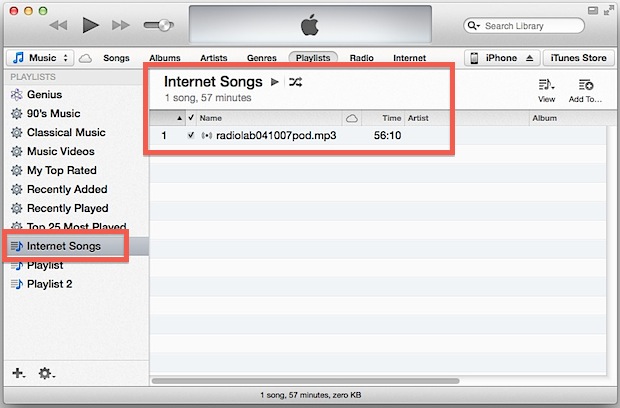
The downside to keeping the m3u file through iTunes directly is that information technology will stream every fourth dimension the sound is accessed, pregnant it won't be available if internet connections are downward or the server is out of reach. That's why downloading the audio content from the m3u container tin be useful.
Converting / Downloading an MP3 / M4A from an M3U File
You can frequently download the m3u playlist audio files directly to a computer, this prevents having to stream the audio through the M3U container. Accordingly, that means you can only "convert" m3u files into local mp3 / m4a files if the container is a URL to audio. If the file is a playlist of local documents, it is not actionable in this fashion.
one: Grab the URL from the m3u
You lot can view the contents of whatsoever m3u with whatever general text editor. OS X makes this specially uncomplicated with TextEdit, the bundled text app, or with Quick Look if y'all have text selection enabled. Just drag the m3u file into TextEdit or open up it with Quick Look, and you'll encounter what'due south in the m3u container, which is either a link to a file or a playlist.

Once y'all have the URL from the m3u playlist, you can then download information technology locally. About users volition want to employ the web browser to accomplish this, but you can also plough to the control line to download the contents from the m3u as well.
2A: Saving m3u Container Audio from a Web Browser
Downloading the contents through a web browser is going to exist easiest for nearly users, it should work with any modern browser in whatsoever mod OS, exist it Safari, Chrome, or Firefox.
- Open up the m3u file in a text editor or Quick Wait, and re-create the URL to the clipboard
- Paste the audio URL into the accost bar of your web browser of choice, permit information technology load, so become to the "File" card and choose "Save As" to save the contained audio to the local difficult drive
You'll probably want to save the resulting mp3 or m4a somewhere hands accessible, like the desktop. Once information technology'due south washed downloading, y'all can open up it direct into iTunes where it will reside with the rest of your audio playlist.
2B: Downloading m3u Container Sound with coil
Users who would rather plough to the command line can utilize curlicue to grab the audio and save information technology locally:
- Copy the audio URL from the m3u container with cat:
- Launch Terminal, then use the following command syntax:
cat sample.m3u
curl -O [url]
Exist sure to specify the full URL and protocol, for example:
curl -O http://non-a-real-url.com/example/path/name.mp3
ringlet will start downloading the file, showing download speed and progress. When finished, it'll exist where you executed the command, which is typically in the user ~/ habitation directory.
Whether you downloaded the file through a web browser of the command line doesn't really matter, but you'll now have the audio file stored locally, preventing the m3u container from streaming the document every time it's opened or retrieved. This can be helpful if you lot'd rather load up your iPhone, iPad, iPod, or reckoner with sound files like podcasts rather than relying on the streaming functionality, and so just load it directly into iTunes and relish.
DOWNLOAD HERE
Posted by: archibaldfornew.blogspot.com


0 Comments